It's much easier to suggest solutions when you don't know too much about the problem.
Talking with different friends who work at large organisations, I notice, with great intensity, the different problems they face: work overload, high staff turnover, too many meetings and free time only at weekends. If we add the relationship problems that throw them off balance personally, they end up not being completely satisfied.
We're human and, even though we work every day, five days a week or just a few days, those problems end up affecting our performance, reaching our objectives and how smoothly we can work.
Are our bosses aware of these problems? What about the HR department? Or the CEO? Maybe the friend who always listens to us knows the causes of the problems, but do the people who make strategic decisions in the organisation know them?
In a previous article, I talked about the power design has to create change in people. To give us a new perspective for reaching objectives. So why not apply it in our work, in our day-to-day or in big projects?
We may have heard about human-centred design, design thinking or some other methodology with the word ‘design’ in the middle. But do we really understand how it can help us?
I really don't think so. Based on different conversations with people who make decisions in different sectors (telecoms, banks, insurance, consultancies, etc.), I've realised we still have a lot to apply, to fail at, to learn and to reflect on in order to create real change.
Of course, I'm not talking about digital transformations, which, although relevant, don't deliver benefits in the medium and long term without a strategy and changes in the processes that support them, in the ways people work and even in the culture.
Why? Because of the complexity of organisations. From the people to the systems they have. Moreover, in many cases, this complexity is created consciously to delay decision-making and avoid certain risks.
However, we're at a moment when our expectations of services are high. We're in the experience economy. It's no longer enough to offer a service or product. We want to be treated well, to be helped with any problem, for them to be honest. Even for them to help us grow as people. We want them to meet a greater number of needs.
Tech companies have helped us respond to these needs. The creation of platforms and mobile apps has made our daily tasks and communication with those around us easier.
But is that enough? I'd think not. We have many more needs floating in the air, the ones that stop us from doing our work easily.
From how we organise our activities, the clarity of our objectives for the year, our physical work environment, knowing whether our ideas get implemented, our expectations, acquiring new knowledge on relevant topics, our professional growth and the spaces to develop personal projects.
One way to approach it is by improving the ‘employee experience’. Mapping all their activities, understanding their problems and dreams, and then offering an improvement in their day-to-day. However, new questions appear: what happens to the processes that support these activities? Who will make the change? Are they aligned with the company's objectives?
As with digital transformations, a strategy and synergy between the different areas are needed to achieve changes with impact. But also tactical changes, simple and easy to implement, to achieve immediate change. Changes that, however small they seem, will later help us achieve much bigger ones. Always with a strategy that lets us know whether that change is relevant or not.
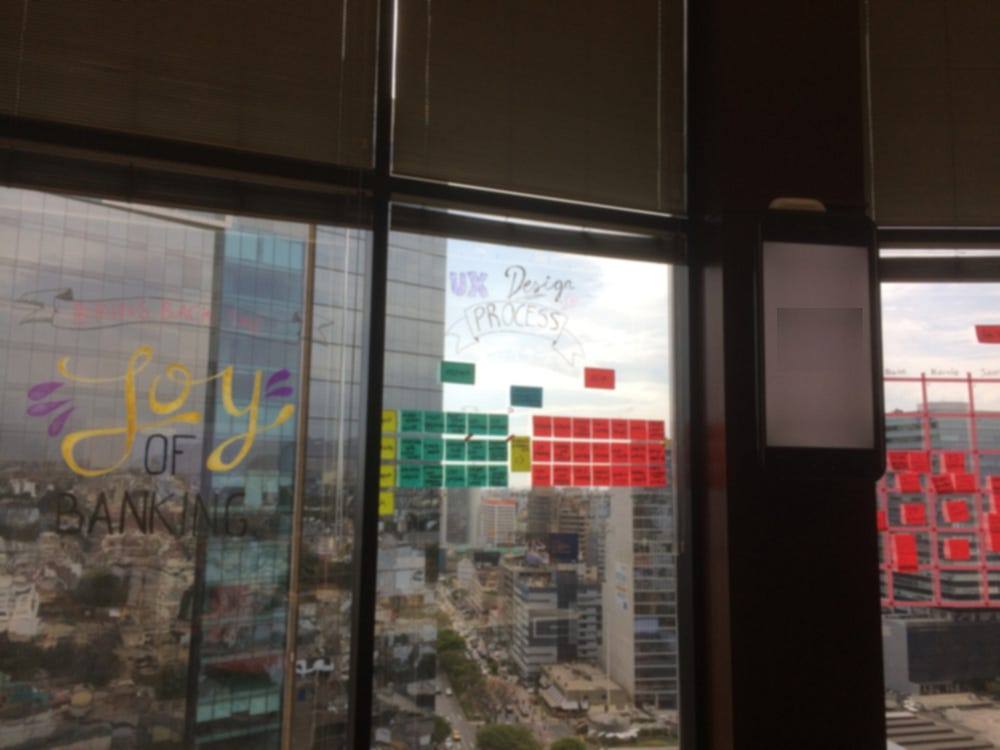
Yes, design thinking has often been associated with post-its, workshops of more than two hours, presentations where they ‘sell’ us an incredible vision, or using agile methodologies that try to solve our problems quickly.
Unfortunately, these actions often don't end up helping us. We reach the end of the year without meeting our objectives and then end up taking on more tasks.
The result? A poor perception of the power of design to create change. It's completely understandable.
On the other hand, different consultancies have also told me how difficult it is to make changes in organisations because of money, the reach of resources or timing. They want to reach the end of the year with the numbers in the black, and if a project starts it has to be aligned with those requirements. Requirements that don't always match what the consultancy is looking for, leading to bewilderment and long faces at the end of the year.
So, do we have a solution? Clearly, yes. But I feel it's a joint effort between organisations and the consultancies that want to create change. Hand in hand, everything is easier, and I feel there's a great opportunity to achieve transformations with a positive impact, not only on the company's economy but also on its workers, suppliers and society in general.
Hand in hand, everything is easier.
More news, very soon.
PS: If you own or are part of a consultancy, or you want to create change within your organisation, get in touch.
It's the little details that are vital. Little things make big things happen.
Have a great day!
Originally written in Spanish as “Ayudando organizaciones” and published on Medium on 3 March 2022. English version by the author, November 2026. Read it in Spanish.